Tuesday, May 22, 2012

5/22

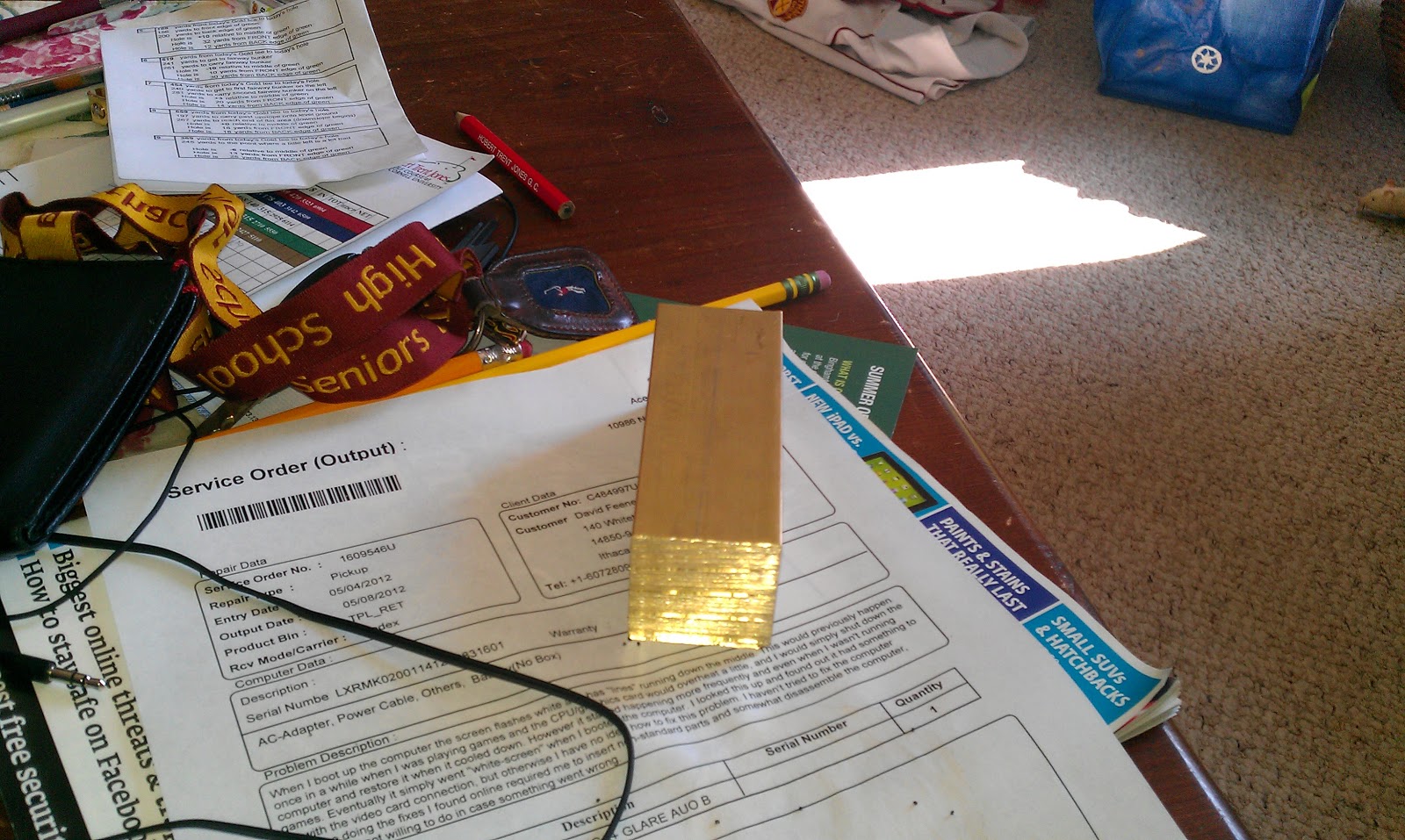
So yesterday I got my block of brass in the mail. As it is right now its about 1.2 kg, or about three times as much mass as the final version is going to be. I plan on taking it in to Mr. Breigle today and then hopefully we'll set up a time to mill it.


From this photo it looks very much like a gold bar, but I assure you I do not have that kind of money. Once I start to mill this bad boy I'll have much more to write about, but right now there isn't much.

Oh, and one more thing that might not seem pertinent to the project but actually is: I failed to qualify for the high school golf state championships after a couple of abysmal days, so the whole part of my project in which I wanted to use this putter during states is somewhat voided. However I will be playing in the NY Junior Amateur qualifier, and will hopefully use it then, although that will be on June 26th, long after school is over, along with my WISE presentation.


Wednesday, May 16, 2012

5/16

Yesterday I met with Mr. Breigle and discussed on how to make my putter the most efficient to drill. I showed him my initial design that I have previously posted about. He suggested that it would be the easiest to mill the head without the top "spoke" that I had before where the shaft inserted into, and so I got rid of it and put the threaded hole in the head of the putter itself.


The shaft bore is at an angle of 19 degrees to the ground because that is the standard angle of most putters. I also had to increase the width of the face from .4 inches to .58 inches in order to get 1/8th of an inch on either side of the bore because Mr. Breigle said he needed at least that much in order to drill the hole without ruining the metal.

Another very important thing is that the metal is now going to be brass; this is the final choice in metal for the putter. I ordered the brass last night. Specifically the brass is 360 Brass, which is considered to be the best brass for milling, like here: http://www.onlinemetals.com/brassguide.cfm; and Mr. Breigle agreed. I ordered a 4x1.5x1.5 rod last night for $30, and it will hopefully get here on Friday, the 18th.

Monday, May 14, 2012

5/14

After another week of not accomplishing much hands-on-wise, I did some researching about golf in general, how to putt, and putter assembly. What I found was very interesting, mainly because of how I found it. For example, before when I searched for putter shaft sizes, I got some very vague results, which I tried to interpret without much success, so I decided on a size I would make and stuck to it. But when I searched for "should I cut down my putter" (I've been uncomfortable with the one I've been using this spring), I found a putter/golf tech forum that had a good list of putter specs that the manufacturer 'Scotty Cameron' uses.

33" Shaft - 350g head
34" - 340g
35" - 330g

I also looked more through Roger Maltby's site, which I've used in the past, and found a much more comprehensive list of putter weight ratios here: http://www.ralphmaltby.com/home/267; and is very helpful; the list goes from the weights of C-0 to E-5, depending on the shaft size. So from what I've found is that aluminum is much too light, density-wise (only 2.7 g/cm^3), to serve as an acceptable material for my putter. Even if my head were to be just a block that's 4x1.3x1, it would still only be 217.62g; much too light for a 30" shaft. From what I could figure out, the D-2 weight from Maltby's site is increasing by 10 for each inch, so if I were to use a 30" shaft then my head weight should be 411g. Doing more calculations, I found that if I were to use stainless steel as my metal (8.0 g/cm^3) then I would need about 51.375 in^3. I'll be modifying my inventor file to try and hit that number as close as possible, and I think it'll be interesting to see what it looks like in the end.

Friday, May 11, 2012

Seven Observations on Learning

So  read an article for homework about how learning works, and our duty was to respond to it by relating two of their observations to our project.

First was that the idea that learning begins with tolerance applies to my project because I've come across many different solutions on how to make my putter, and I've accepted some solutions, put aside others, and rejected a method or two.

Second was that learning is inconclusive and that's basically how I've been researching so far because with every new thing I have brings up new questions; just like when I learned that milling metal sometimes requires coolant, I then tried to figure out what kind of coolant was best for aluminum, how much I need, or do I even need coolant.


Sources used since 2/1

Since Mr. Creagan recommended to me that I do a blog post of all the sources I've had so far for my research, this is my blog post for them. I had almost 30 sources before I started this project; these are just the sources I've used since I started the project and I haven't had to use much outside of my initial research.
All of my sources so far:

http://findarticles.com/p/articles/mi_m0HFI/is_3_54/ai_100463197/
For when putter grooves were first used and CNC machining putters

http://www.gelputter.com/
Different kinds of putter faces

http://www.andrewricegolf.com/tag/putter-weight/
How much putters usually weigh

http://www.franklygolf.com/gripsizeandputterweight.aspx
Another source on the weight of putters

http://csquaredgolf.com/tag/putter-head-rotation/
General swing path of a putter

http://puttingzone.com/MyTips/lengthlie.html
Very useful site for putter shafts, including lengths, lie of the shaft to the ground, etc.

http://puttertalk.com/community/index.php?topic=25054.0
This was very helpful in determining how wide the putter shaft is

http://golf.about.com/od/faqs/f/shaft_weight.htm
Good for figuring out how much heavier my shaft was compared to metal ones

http://www.cnczone.com/forums/general_metal_working_machines/20588-what_coolant_do_you_use.html
Different kinds of coolant


Thursday, May 3, 2012

Happiness Revisited


We read an article on Happiness a while back in class and this is just my response to it.
When do I feel the most happy?
I feel the most happy when I am out playing golf, although it’s not always the most rewarding or satisfying experience. Being able to escape for a couple of hours is very relaxing, and at the same time golf gives a challenge that I love and will always be there. There are other things that are enjoyable for me, like reading, going places with friends, video games, etc, but none can relax and challenge me at the same time.

Respond to the article:
I found the article very interesting after writing that first response to what makes me happy, since the article’s author found  a combination of skill and challenge that would make people the most happy, and I can really relate to that since I always like to challenge myself and when I have the skill to meet that challenge I really enjoy myself. This “flow” he talks about I think I can relate to very much, and have also experienced a kind of it when doing calculus or playing a rhythm game.

Where am I on the flow chart?
With life, I believe that I am probably a little north of the “flow” zone, since right now I’m a little overwhelmed with school, but other than that I think I’m right in the middle of the flow otherwise.

How has my "flow" changed throughout the course of my project?
Well I think that it probably has been a little in the "boring" zone so far just because everything I've done hasn't been extremely challenging, although it has taken a good bit of effort and creativity so far for coming up with ideas for the head design, different materials, etc. But I have had fun with the project and I don't feel overwhelmed with it, and I guess so far I've had a pretty positive experience.

How can I achieve flow?
Well I think in my activities outside of school I've done that pretty well, but with life in general I think I need to start to realize my shortcomings and the fact that I cannot do everything in life or be the very best in whatever I choose to do. So if I were to achieve flow in life I would have to lower my expectations for myself. However, this is something I cannot do, or else I fear I will lose all drive to become something better than I am right now. Setting unrealistic goals is my way of achieving important goals, and putting myself in a "challenging" area like the article suggests is just how I want to become a better, more well-rounded person. Maybe in retirement I can finally sit back and be truly happy, but until then I don't think living in a state of bliss is how I want to go.

Monday, April 2, 2012

Update 4/2

Well, unfortunately I haven't been able to do very much over the past week. I wanted to talk to Mr. Breigle about the CNC Mill and coolants and such like I said I was going to last week, but it turned out that he was away every day except Wednesday, when I had no free time. I did play around with Edgecam a bit more but couldn't do much since all I could really do was figure out milling profiles and how to change at what angle I mill the face. The more important aspects of milling depth, feed, and spin were out of reach since I first don't know what kind of aluminum alloy I'll be buying, so I don't know how fast to spin the mill, and also I have no idea how fast I can make the feed due to the moderately tight turns the drill bit would do in order to profile the putter head. I don't have any experience milling metal, only some waxy stuff and soft wood we used back in CIM my sophomore year, so I don't know how much the mill can handle.

I guess this is really my first big stumbling block, and until I can find time with Mr. Breigle, which I hopefully will this week since spring break is next week, I'm not going to be able to get much farther with my project.